I like people. Quite a lot, actually. I’m an extrovert and I get energy from being around other human beings: training rooms, coaching conversations, lunches that run longer than expected because somebody says something interesting just as you’re supposed to leave. Put me in a room with people and there’s a reasonably good chance I’ll leave with more energy than I had when I arrived.
Which makes one aspect of my working life slightly inconvenient: coaching can be surprisingly solitary.
There are weeks when I’m moving between conversations, working with clients or groups, exchanging ideas and barely noticing the time. My diary is full, my brain is full and, usually, I’m pretty happy with both. And then there are other periods when the diary goes quiet. A few cancellations coincide, a piece of work finishes, another hasn’t started yet, and suddenly there is rather more Gareth in my working week than I had anticipated.
The strange thing is that the silence itself isn’t necessarily the problem. It’s what I can make the silence mean.
An empty diary can become remarkably judgemental if you stare at it for long enough.
WHAT HAPPENS WHEN NOTHING MUCH IS HAPPENING?
I go for a walk around Lake Genval on one of those quiet days. I’m ostensibly going for the fresh air, although I suspect I’m really hoping that if I walk for long enough I’ll somehow locate a sense of purpose somewhere between the lake and the trees.
Nothing is particularly wrong. That’s almost the irritating part. There isn’t a crisis to solve or a decision demanding my attention. There is simply space where activity normally lives, and I’m discovering that I don’t always know what to do with it. Before long, the questions begin. Should I be doing more? Why isn’t something happening? Is everybody else busier than me? Am I falling behind? And, because we live in a world where it’s possible to check almost instantly whether everybody else appears to be more successful than you, there’s always LinkedIn available if I’d like to make the situation considerably worse.
Somewhere during the walk, I begin thinking about resilience.
I’ve never been particularly comfortable with the heroic version of resilience. The one where we bounce back stronger, push through adversity, discover previously untapped reserves of strength and emerge triumphantly from difficult circumstances, preferably with a useful acronym explaining how we did it. There are certainly times when resilience looks like endurance, but I’m increasingly interested in the less dramatic version. The resilience required when nothing catastrophic has happened, but the shape of things has changed. When you’re between one thing and whatever comes next. When the world isn’t constantly providing evidence that you’re useful.
Perhaps resilience has something to do with what we do then.
THE TREES ARE HAVING NONE OF IT
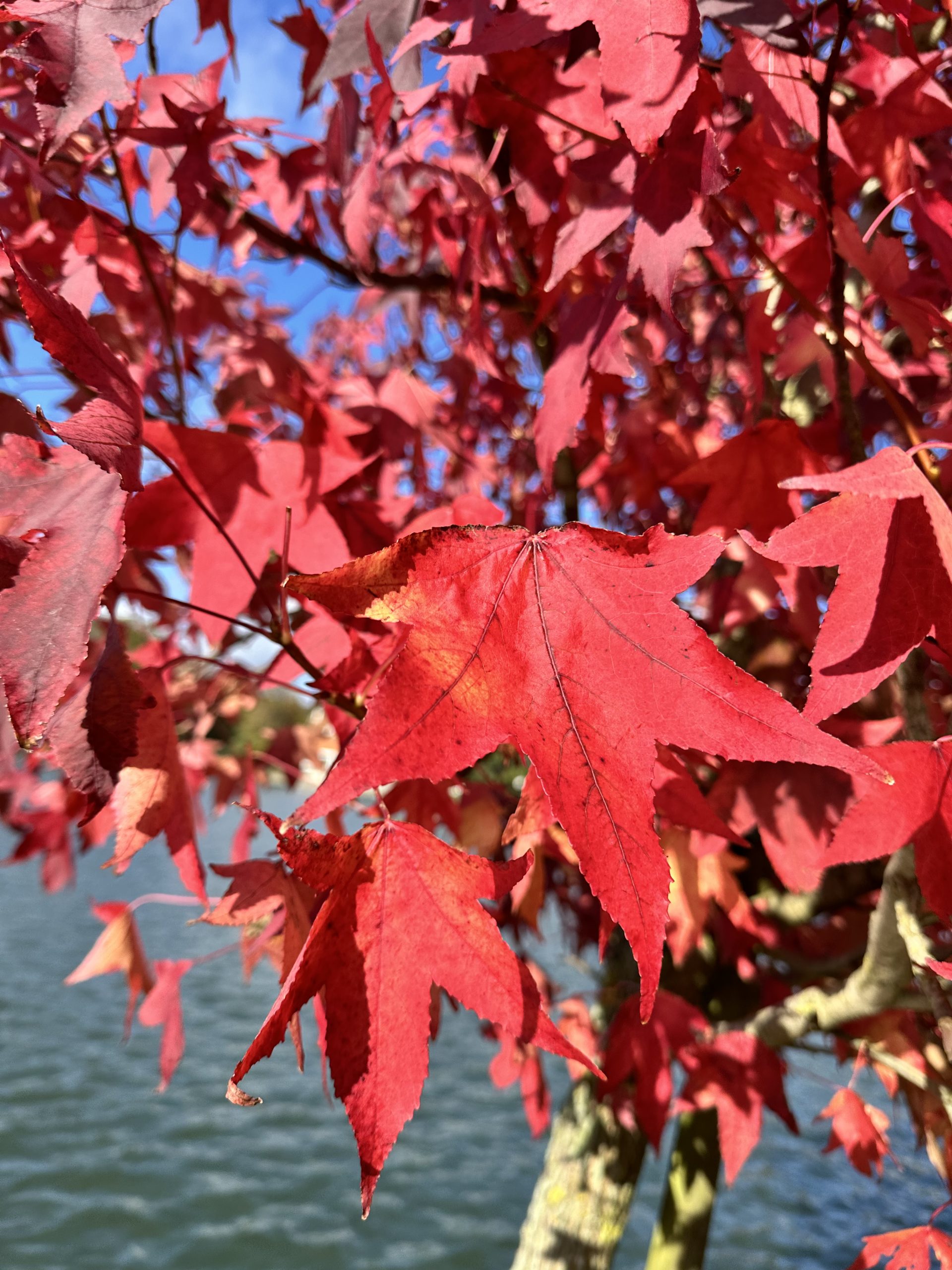
Lake Genval is beautiful in autumn. The trees around the water seem completely unconcerned with synchronising themselves. Some are still predominantly green, others have turned gold or red, and some appear to have given up on leaves altogether. None appears especially troubled by the fact that the tree twenty metres away is doing autumn differently.
I realise I’m watching them while simultaneously doing exactly that with other people.
The metaphor is not exactly subtle. I could probably have done without nature making its point quite so clearly.
But it makes me wonder whether some of what I call resilience has less to do with enduring difficulty and more to do with my relationship with change, particularly those stretches where one thing appears to be ending and whatever comes next hasn’t properly announced itself yet. We tend to like growth when it looks like accumulation: more clients, more work, more responsibility, more opportunities, more evidence that things are moving in the right direction. I’m not sure we’re quite as enthusiastic about the parts of growth that involve less.
Less certainty. Less activity. Less noise.
Space.
Not everything that looks empty is asking to be filled.
That’s considerably easier to write than it is to live.
WHO ARE WE WHEN NOBODY NEEDS US?
There is another part of this that feels particularly relevant to my work because a substantial part of my working life involves being useful to other people. Not useful in the sense of having all their answers — hopefully I’ve learned better than that — but useful in the sense of being present for something. Someone arrives with a question, a challenge, a decision or simply a desire to think, and for a period of time I have a role in that.
Then the conversation ends. The client leaves, the laptop closes, the training room empties, and I’m back with myself.
I don’t think coaches are remotely unique in this. Plenty of professions organise themselves around being useful to other people. Leaders experience it. Parents certainly experience it. Anyone whose identity becomes entangled with what they provide for others probably recognises something of it. Being needed can be enormously rewarding, but it can also become very good at disguising the question of who we are when nobody currently needs anything from us.
That is a rather uncomfortable question.
I don’t have a particularly elegant answer to it, either.
Perhaps that’s why I keep walking.
SOLITUDE ISN’T THE SAME AS LONELINESS
My instinct is still towards connection. A walk around a lake isn’t going to transform me into somebody who wants to disappear into a cabin for six months and communicate exclusively with squirrels. If I’ve spent too long alone, I want people. That isn’t something I’m particularly interested in curing.
But I am becoming more interested in the distinction between loneliness and solitude. Loneliness feels like the absence of connection I want. Solitude can contain something else: space to notice what gets drowned out when everything is busy.
A surprising amount of my writing begins there. Ideas arrive while I’m walking. Thoughts that have been knocking around somewhere in the background finally become loud enough to hear. Sometimes creativity appears precisely because there is nothing else demanding my attention. Occasionally I discover that something I thought was a problem is really just my discomfort with not having anything immediate to solve.
And yet I’m wary of turning solitude into another productivity technique. There would be something slightly ridiculous about learning to tolerate empty space only because I’ve discovered a way of making it useful.
Sometimes a walk is just a walk. Sometimes a quiet afternoon produces absolutely nothing. Sometimes I am bored.
Maybe that’s allowed too.
PERHAPS RESILIENCE ISN’T A SOLO ACT
There’s a version of resilience I don’t particularly like: the relentlessly self-sufficient person who absorbs everything, adapts to everything and continues regardless. We tend to admire that kind of independence, but from where I’m standing it sounds exhausting.
My own experience of resilience is much more relational. Some of the things that allow me to continue doing work I care about happen precisely because I don’t try to contain everything myself. There are friends, colleagues and conversations that have absolutely nothing to do with coaching. There are people who make me laugh when I’ve become far too interested in my own thoughts. There is my own reflective practice and supervision, where the things that arise through the work have somewhere appropriate to be thought about rather than simply carried.
Support doesn’t seem to me to be evidence that resilience has failed. It might be part of how resilience works.
The same is true of solitude. The ambition isn’t to become so resilient that I no longer need people, any more than the answer to an empty diary is to fill every available space with activity. Perhaps the capacity I’m developing is simply a greater range: being able to enjoy connection without desperately needing constant activity, and to experience solitude without immediately translating it into a story that something is wrong.
That feels considerably more useful to me than “bouncing back”.
THE DIARY WILL FILL AGAIN
By the time I finish walking around the lake, nothing dramatic has happened. I haven’t solved resilience, the trees haven’t revealed the secret to personal development, and my diary is no fuller than it was when I started.
But something about my relationship with the space has shifted.
There are periods when work is abundant and exciting and I’m surrounded by people. There are periods when things contract. There are days when I feel extraordinarily purposeful and others when I wander around a lake wondering what exactly I’m supposed to be doing with myself. Neither seems particularly permanent, however convincing it feels while I’m inside it.
Maybe resilience has something to do with being able to live through all of those states without requiring one particular version of life to last forever. To recognise when we need other people and go towards them. To recognise when the quiet is becoming loneliness and do something about it. But also, perhaps, to notice when we’re rushing to fill a space simply because being in it makes us uncomfortable.
The extrovert in me would still quite like somebody to call.
But until they do, perhaps the quiet doesn’t need fixing.
Perhaps it is simply quiet.
