Team Coaching in Brussels & Online
A team is more than the sum of its people.
What makes the difference is how they work together.
Every team develops its own way of working.
Ideas collide. Relationships form. Roles emerge. Habits develop. Some voices become louder. Others quieter. Teams find ways of making decisions, dealing with disagreement, sharing responsibility and getting things done.
Some of those patterns help the team.
Some quietly get in its way.
Team coaching in Brussels and across Europe with me makes those patterns easier to see — and possible to change.
Not to turn everyone into better team players.
To help the team become more aware of how it works — and what else might become possible.
What brings a team to coaching?
Sometimes there’s a problem everyone can name.
Sometimes there isn’t.
A team might be navigating change, struggling with a particular dynamic, or simply becoming curious about whether the way it works together is still serving what it needs to do.
SOMETHING HAS CHANGED New leadership. New people. New responsibilities. The team needs to find its feet again. | WE KEEP GETTING STUCK The same conversations. The same frustrations. Somehow, we keep ending up back here. |
WE’RE NOT SAYING IT Something is affecting the team, but the conversation itself has become difficult to have. | WE’RE PULLING IN DIFFERENT DIRECTIONS We’re all working hard. We’re just not always sure we’re working towards the same thing. |
WE WORK WELL — AND COULD WORK BETTER There doesn’t need to be a crisis. Sometimes a good team is ready to become more conscious about how it works. | WE NEED SOMETHING DIFFERENT NOW What got this team here may not be what it needs for what comes next. |
You don’t need to wait until a team is struggling.
Curiosity is a good enough reason to look.
What happens in team coaching?
We work with the team that’s in the room.
Team coaching isn’t a programme I deliver to a team.
We begin with what the team is here to do, what it needs from its relationships and ways of working, and what is happening now.
And we pay attention to the work — and to how the work gets done.
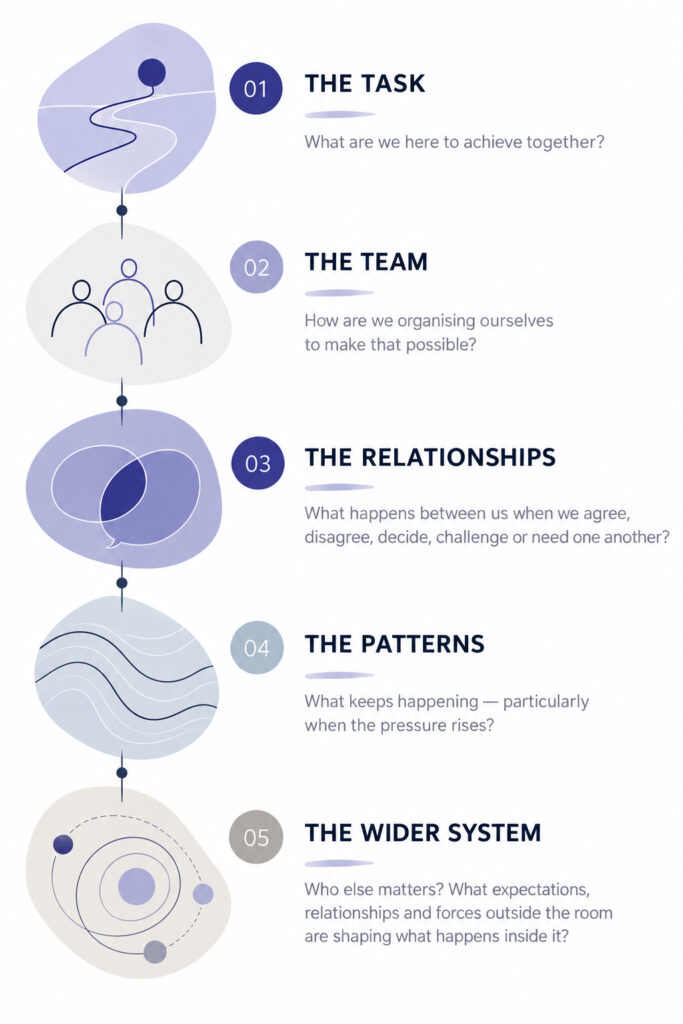
Sometimes we’ll work with a live challenge the team is facing. Sometimes we’ll notice something happening between people in the room and work with it there and then.
We might slow a conversation down, surface an assumption, experiment with a different way of deciding, or simply notice a pattern the team has stopped noticing.
The team becomes both the client and the material.
We don’t just talk about how the team works. We work with it while it’s happening.
When you can see the pattern, you can do something differently.
Teams develop ways of working together for good reasons.
A quick decision here. An avoided conversation there. Someone steps in. Someone else steps back. Something works, so the team does it again.
Eventually, a response becomes a habit.
And a habit can start to feel like simply “how we are.”
NOTICE
What is actually happening?
UNDERSTAND
What might be creating or sustaining it?
EXPERIMENT
What happens if we try something different?
CHOOSE
What do we want to take forward?
The aim isn’t to tell a team how it should work.
It’s to give the team more choice about how it wants to work.
Sometimes it helps to see the team differently.
Conversation tells us a lot. Data can show us something else.
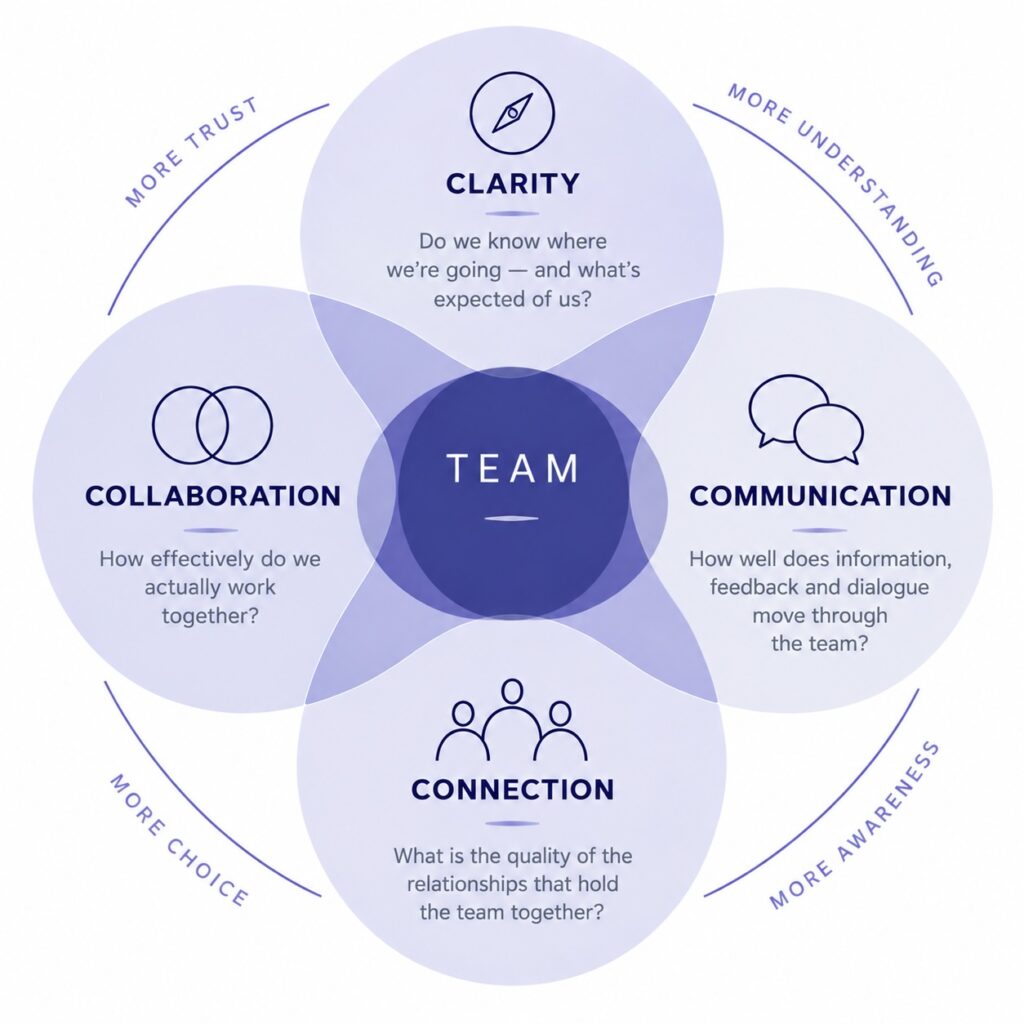
As part of our work, we can use the Team Cohesion Index to give the team another way of looking at itself.
Rather than measuring individuals or creating personality profiles, it explores how people experience the team they are part of — and where those experiences converge or differ.
It gives us something concrete to become curious about.
The numbers aren’t the answer.
It’s the questions they generate which really drive the difference.
A result might confirm something the team already knows.
It might reveal that people are experiencing the same team very differently.
Or it might bring something into the conversation that has been difficult to name.
We don’t use the report to tell the team what’s wrong. We use it to become curious about what might be happening.
Not every team needs a diagnostic.
Sometimes the work begins with data.
Sometimes it begins with a conversation.
Sometimes it begins with something happening in the room that nobody expected.
We choose what will be useful for the team — rather than fitting the team into a predetermined process.
What might working together look like?
There isn’t one way to coach a team.
Sometimes a team needs space around one particular conversation. Sometimes something has changed and the team needs to find a new way of working together. And sometimes the most useful work happens over time.
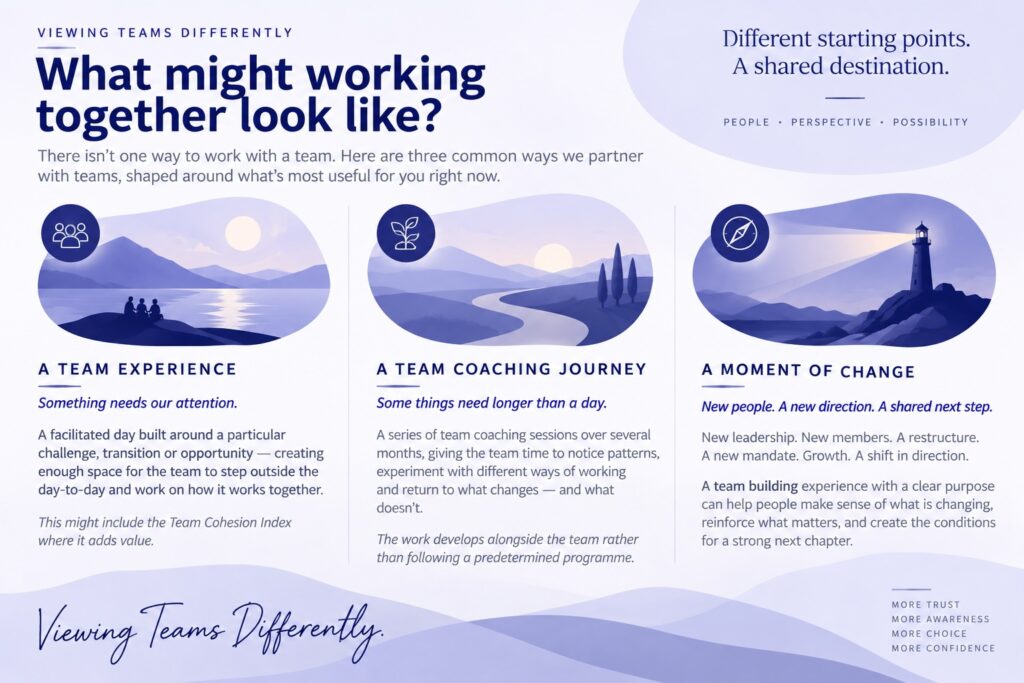
We’ll design the work around the team.
That might mean one day together.
It might mean a series of conversations.
It might involve individual stakeholder conversations, a diagnostic, team coaching sessions or moments of reflection between them.
We’ll use what helps. And leave out what doesn’t.
Teams are rarely standing still.
Teams form, grow, change direction, lose people, gain people, inherit new responsibilities and find themselves facing things nobody anticipated.
Sometimes the world around it has changed.
A NEW TEAM
People are coming together and need to create something that doesn’t exist yet.
AN ESTABLISHED TEAM
There’s history here. Ways of working have developed — some worth protecting, others worth reconsidering.
A LEADERSHIP TEAM
You’re not only responsible for your own areas. How you work together shapes what happens throughout the organisation.
A TEAM IN TRANSITION
New leadership. Restructuring. Growth. Merging teams. A change of mandate. Something familiar is becoming something else.
Every team has a context.
(We work with that too).
A team doesn’t exist in isolation.
There are stakeholders, customers, colleagues, organisational pressures, histories and expectations beyond the people in the room.
So our work can include the wider system — understanding what the team is being asked to do, who it needs to do it for, and what those relationships might be asking of the team.
Because changing the conversation in the room matters most when something changes outside it.
We don’t need to know the answer before we begin.
Perhaps you already know what your team needs.
Perhaps you know something needs attention, but you’re not yet sure what the work should look like.
Or perhaps you’re simply wondering whether team coaching, a team experience or something else entirely would be useful.
That’s enough for a first conversation.
Who should be part of that conversation?
Sometimes it begins with the team leader. Sometimes HR, Learning & Development or another organisational sponsor is involved.
We’ll talk about what’s happening, what you hope might become different, who the work is for and what needs to be considered before bringing the wider team into the conversation.
From there, we can decide together what — if anything — makes sense.
Brussels. Across Europe. Online.
I work with teams in Brussels and internationally, in person and online.
Depending on the work, we can meet at your organisation, use an external space that gives the team some distance from the everyday, or work virtually when the team is geographically dispersed.
What’s happening in your team?
No predetermined programme. No need to diagnose the problem before we speak.
Just a conversation about the team, the context and what might be useful.